
OEM/ODM Jewelry Manufacturing: Prototype, Sample, Batch
A custom jewelry programme produces three physical objects before it produces a shipment: a prototype, an approved master sample and a bulk batch. TTT Jewelry places 48 hours of CAD ahead of the first, 25–30 days inside the second and 21–28 days inside the third. Each object answers a different question, and treating them as three versions of the same thing is how a launch ends up with a beautiful sample it cannot reproduce.

Key takeaways
- Three checkpoints, three questions: geometry, process, repetition.
- CAD closes in under 48 hours, which is 2 days against a 25–30 day sampling window.
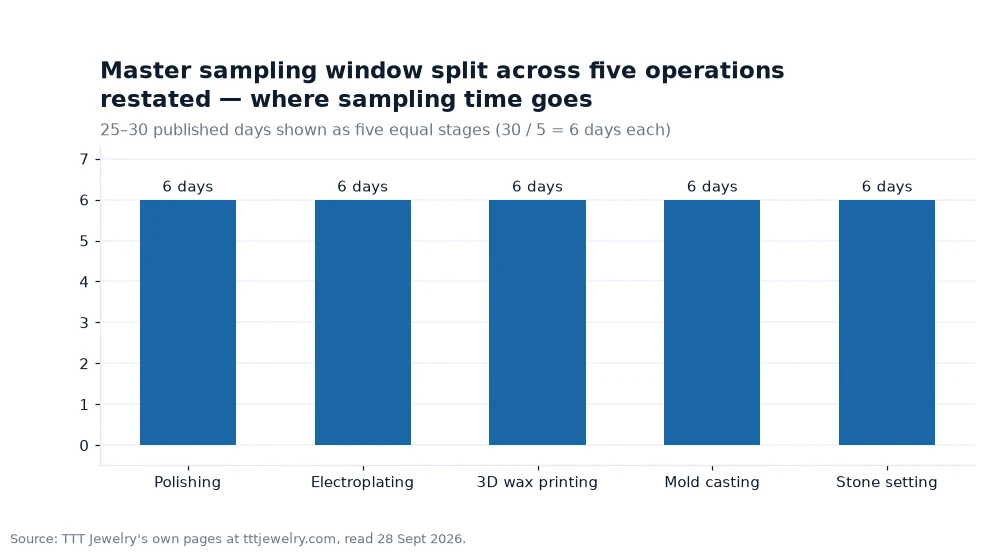
- Sampling divides into five operations of roughly 6 days each at the top of the range.
- Bulk adds 21–28 days and ends with 100% inspection, not a spot check.
Three objects, three different questions
A prototype asks whether the shape is right. A master sample asks whether the factory can produce that shape in the specified metal, finish and plating. A bulk batch asks whether the process repeats at quantity without drifting.
Engineers separate these because a pass at one stage says nothing about the next. A pendant can look correct in printed resin and still be unwearable at 3.2 grams of silver with a stone seat that will not hold a prong. A master can be perfect and a batch can still show colour variation across two plating baths.
Buyers who collapse the three into a single "sample" conversation usually discover the distinction at the worst moment, which is after the purchase order has been signed and the mould has been cut.
Prototype: geometry before metal
Prototyping at TTT Jewelry runs by mould or by 3D printing, following the CAD model that closes in under 48 hours. The purpose is cheap iteration: change a curve, thicken a band, move a bail, without touching production tooling.
What a prototype proves is fit and proportion. What it cannot prove is weight in the final metal, plating colour, stone security or the behaviour of a clasp under repeated use. A resin print at 1.1 grams tells you the silhouette works and nothing about whether the silver version will feel substantial on a wrist.
This is the stage to spend design changes on. Every revision after the master is approved costs a mould adjustment or a remake, and the published sampling window assumes one master per design rather than a sequence of them.
Master sample: proof of process
Master physical sampling takes 25–30 days and produces one approved master per design, made in the correct metal with the correct finish and plating. It is the first object in the programme that can be weighed, worn, photographed for the sales sheet and handed to a buyer for a decision.
It is also a manufacturing document. Once signed, the master fixes surface finish, plate thickness target, stone setting method and the dimensions that inspection will check. The drawing becomes a reference; the object becomes the specification. That inversion is the whole point of the stage.
Silver and brass add a step that stainless does not: anti-tarnish e-coating over the plating. A master judged before the coat is applied can look different once the barrier is on, particularly on brushed surfaces where the coat can flatten texture. Approve the coated piece.
The sampling window is not one operation. Read as five stages, the top of the published range divides into roughly six days each: growing the wax, casting the mould, setting stones, polishing and electroplating. At the low end the same five compress to about five days each.
| Sampling operation | Indicative days at 30 | What it settles |
|---|---|---|
| 3D wax printing | 6 | Shape and scale in a burnable material |
| Mould casting | 6 | Metal soundness, wall thickness, sprue placement |
| Stone setting | 6 | Seat depth, prong security, stone alignment |
| Polishing | 6 | Gloss level and edge definition before plating |
| Electroplating | 6 | Colour, coverage and adhesion of the plate |
The split explains why one design change late in the window is expensive. Moving a stone seat after casting sends the piece back to setting and re-polishing, and both sit downstream of the mould.
Batch: proof of repetition
Mass production is quoted at 3–4 weeks, or 21–28 days, and repeats the approved sequence on the approved mould. The interesting risk here is not design failure but drift: plating colour between lots, dimensional variation across a long run, packing that slowly departs from the approved spec.
TTT Jewelry closes the run with 100% inspection, meaning every piece is checked rather than a sample drawn from the batch. On a 100-piece order that is 100 individual checks; the burden per unit is higher on a short run than a long one, which is one reason small orders are not simply large orders divided down.
A full service jewelry OEM manufacturer should be able to say which characteristics inspection actually measures. If the answer is only "visual", colour and dimension are being judged by eye across thousands of units, and the master is doing less work than it should.
Sign-off discipline between the three objects
Each handover needs a named approver and a version number. Without them, "approved" means different things to a merchandiser, a designer and a factory planner, and the disagreement surfaces when a batch arrives in the wrong finish.
ISO 9001:2015 provides the frame for this: documented stages, recorded checks and a traceable link between the approved master and the production unit. The standard does not make a design good. It makes the route from approved object to shipped object auditable, which is what a brand needs when it reorders the same design eighteen months later.
Keep the approved master in the factory and a duplicate with the brand. Reorders are priced and scheduled against it, and a missing master turns a repeat order into a development project again.
Worked example
Take a pendant in 925 sterling silver with one 4 mm stone. CAD closes at under 48 hours, so 2 days. Sampling runs the full 30 days. Production runs 28 days. Total: 2 + 30 + 28 = 60 days, the top of the published range.
Inside sampling, each of the five operations holds 6 days, and 5 × 6 = 30. At the fast end, 5 × 5 = 25. So the 5-day swing between the two published bounds is one day per operation, not a single delay at the end.
CAD is 48/720 = 6.7% of the 30-day window, or 48/600 = 8% of the 25-day one. Production is 21–28 days, so the whole programme is 48–60 days, roughly 7 to 9 weeks.
Now scale the order without scaling the calendar. Three pendants briefed together send three masters through the same 30 days, so the total stays 60 days while the work triples. Three pendants briefed three weeks apart finish roughly six weeks apart, because each waits for the bench slot the previous one occupied.
Frequently asked questions
What does a master sample prove that a prototype cannot?
The master proves the process: the design cast in the final metal, finished and plated as it will ship, with stones set. A prototype proves shape and scale only, so weight, colour and stone security remain untested.
How long is the gap between approved sample and shipping?
Bulk production takes 21–28 days after written approval, and freight follows. Nothing in that window includes buyer review time, so late feedback pushes the ship date day for day.
Can several designs share one sampling window?
Yes, provided the briefs arrive together. Six designs released as one batch move through the same 25–30 days; staggered releases queue behind one another and multiply the elapsed time.
Keeping the three proofs separate
The discipline is simple to state and hard to hold: do not approve a batch on the evidence of a prototype, and do not approve a prototype as if it were a master. Each object carries a different promise, and the paperwork should say which one is being signed.
Range planning follows the same logic. A capsule that mixes metals needs the minimums checked per material, since a sterling silver jewelry manufacturer starts at 50 pieces per design while the brass line starts at 100.
For a first drop, the cheaper proof is often the brass version: custom brass jewelry carries the same sampling window at a lower metal value, so a shape can be tested in the market before it is committed to silver.
Three objects, three decisions. A programme that keeps them distinct spends its money on the stage where a change is still inexpensive.
Source note: figures come from the manufacturer's own website (tttjewelry.com), read 28 Sept 2026.[1]