
Allergen Labelling QC Checkpoints on a Value-Priced Fragrance Line
Allergen labelling on a value line is decided long before a quality inspector opens a carton. The declaration on the label is only as good as the compound data, the concentration assessment and the naming round that produced it, and none of those can be retrofitted at final inspection. The five checkpoints below are ordered by leverage: the first two prevent the problem, the third records it, and the last two keep it from drifting after approval. A quality team that only owns the last two is auditing a decision somebody else already made.
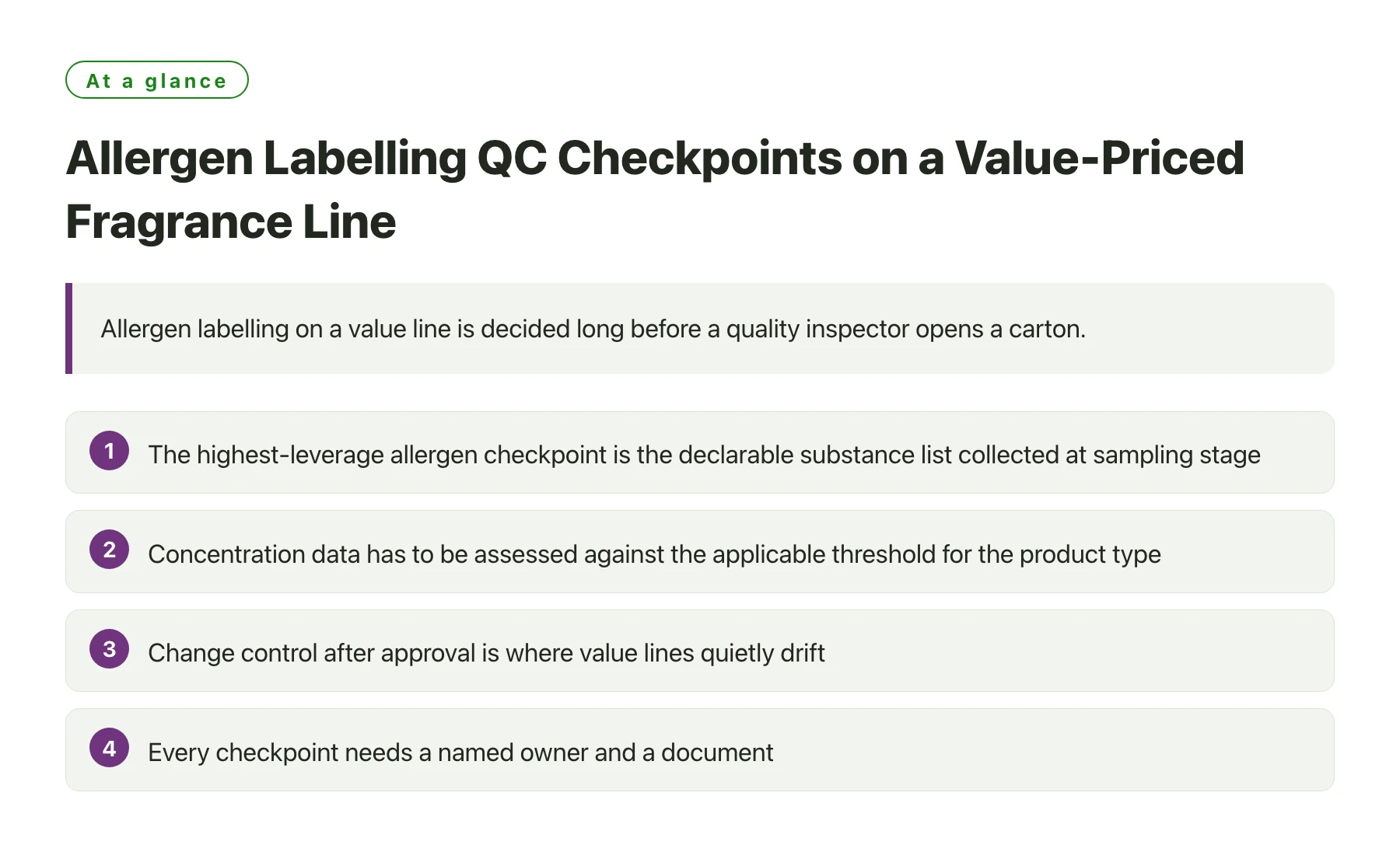
Key takeawaysThe highest-leverage allergen checkpoint is the declarable substance list collected at sampling stage, because everything downstream is a consequence of it. · Concentration data has to be assessed against the applicable threshold for the product type, and leave-on and rinse-off products do not share the same threshold. · Change control after approval is where value lines quietly drift, because a cost-driven substitution can alter the declaration without anyone re-reading the label. · Every checkpoint needs a named owner and a document; a checkpoint that produces no artefact is a conversation, not a control.
Quality control in fragrance manufacturing is usually described as a sequence of tests. On the allergen question, testing is the least interesting part. A laboratory can tell you what is in a compound; it cannot tell you whether the ingredient list was written before the packaging was ordered, whether the threshold assessment used the right product category, or whether a supplier changed a raw material two months after approval.
That is why allergen compliance behaves like a design control rather than a final inspection. The cheapest place to catch a problem is at the moment the brief is written, and the most expensive place is a filled pallet waiting for a container. For brands building an entry-price range, the checkpoints need to be chosen for leverage rather than for completeness, because no small team can run every possible test on every batch.
Checkpoint one: the declarable substance list, asked for at sampling
The first control is a document request, not a measurement. When a sample is submitted for approval, it should arrive with a statement of which declarable fragrance substances are present above the relevant threshold and which are absent. That single document determines whether the artwork can be finalised, whether a reformulation is still possible, and whether the product information file will be assemblable later without a scramble.
The reason to ask this early is bargaining position. Before a purchase order exists, a brand can still choose a different compound, or ask for a minor adjustment, at low cost. After approval, the same request becomes a change, with resampling, stability work and often a reprint attached. On a value line the second version of that conversation is frequently unaffordable, so the checkpoint has to be moved forward rather than managed better. There are other questions worth settling with a candidate factory at the same stage, which is why what to check before choosing a perfume factory is a useful companion to this list.
Checkpoint two: concentration against the right threshold
A substance list without concentrations is not enough, because declaration depends on how much is present relative to the limit for that product type. Leave-on and rinse-off products are assessed against different thresholds, and a body lotion, an eau de toilette and a shampoo are not interchangeable for this purpose. The assessment has to be made against the intended use, not against the most convenient category.
This is also the checkpoint where a brand should verify that the substance names it is comparing are current. The European Commission maintains a cosmetic ingredient database that lists ingredient names, and it is a practical first stop for confirming how a substance should be described [1]. A mismatch between the compound supplier's internal naming and the recognised nomenclature is one of the most common causes of a late label change.
For fragrance materials, the industry's own standards library is the other reference point, because it sets use restrictions that inform how a material can be applied at all [2]. Declaring a restricted material correctly does not make it compliant; the restriction applies to the formulation itself, and that is a development question rather than a labelling one.
Checkpoint three: the paperwork that closes it
| Document | What it has to show | Who keeps the original | The gap that shows up on a value line |
|---|---|---|---|
| Compound allergen statement | Declarable substances above threshold, with the basis for the assessment | Brand, in the product information file | A product code instead of a substance list |
| Concentration assessment | Levels checked against the threshold for the intended product type | Regulatory affairs or the responsible person | One assessment reused across leave-on and rinse-off versions |
| Ingredient list, final | Recognised nomenclature, in the required order of declaration | Brand and packaging supplier | Marketing names carried into the technical file |
| Safety report reference | Confirmation that the assessment covers the marketed formulation | Responsible person | Report produced for an earlier version of the formula |
| Approval record | Who signed the formulation and the label, and when | Brand | Approval given verbally in a chat thread |
The fourth column is where a quality team earns its keep. Documents are rarely missing entirely; they are present but one version behind. A checklist that asks for the artefact, names the version and dates the sign-off catches most of it, and the buyer who can hand that checklist to a candidate factory is already ahead of most of the market.
Checkpoint four: the first production run
Once a formulation and label are approved, the first production run is a confirmation exercise rather than an evaluation. The quality question is whether the batch was produced from the approved compound and filled, labelled and packed against the approved specification. Allergen labelling is affected indirectly but importantly: a substitution made to keep a run on schedule can change the declaration.
Two things are worth insisting on for a first run. First, a retained sample of the bulk and of the filled unit, held with the batch record, so that a later question can be answered from evidence rather than memory. Second, a written confirmation that the compound batch used matches the approved reference. Both are ordinary requests, and a supplier who treats them as ordinary is a different kind of partner from one who treats them as special favours; a factory that handles fragrance R&D and production tends to keep those two records in one place.
The practical test of a real production capability is not the certificate on the wall but whether the batch record and the retained sample can be produced on request six months later, without a search, and whether the person who produces them understands why they matter.
Checkpoint five: change control after approval
Most allergen incidents on value lines do not start with a bad formula. They start with a good formula that was quietly adjusted. A raw material becomes unavailable, a cheaper equivalent is proposed, a supplier reformulates an intermediate, and the ingredient list on the shelf no longer matches the product inside. Nobody intended to break the declaration; nobody was asked to re-check it either.
The control is procedural and cheap: any change to a fragrance compound, to a raw material source or to a stabiliser should trigger a re-read of the allergen position and the ingredient list before the change is accepted. Putting that sentence into the supply agreement costs nothing and removes an entire class of late discovery.
This is also the checkpoint that most rewards choosing a supplier where both OEM and ODM fragrance production sit under one roof. The fewer parties involved in compounding, filling and labelling, the fewer places a silent change can enter the chain, and the fewer versions of the ingredient list can exist at once. Buyers who want to see how a supplier describes that chain before committing can read it on the Xuelei official website alongside the technical documents it publishes.
Who signs the change control, and what they sign
Assign one person to approve formula changes and require the approval to state whether the declaration is affected. If that field does not exist on the form, it will never be filled in. Two lines on a change note are the difference between a controlled declaration and an assumption.
A value line does not need more checkpoints than a premium one, it needs earlier ones. The five above cost almost nothing to operate if they are written into the brief, the supply agreement and the approval form. They are expensive to reconstruct after a pallet has been printed.
Sources
- EU CosIng — Cosmetic Ingredient Database (European Commission) —— The European Commission's CosIng database of cosmetic ingredients, listing ingredient functions, restrictions and labelling requirements under EU cosmetics law.
- IFRA Standards Library (International Fragrance Association) —— The IFRA Standards Library lists the restrictions the fragrance industry applies to individual fragrance ingredients, based on safety assessments; it is the reference point for compliant fragrance formulation.
Frequently asked questions
How many QC checkpoints does allergen labelling actually require?
Five are usually enough: the declarable substance list at sampling, the concentration assessment against the correct threshold, the documentation set, the first production run confirmation, and change control after approval. Adding more inspections does not help if the first two are skipped.
Is allergen testing necessary if the compound supplier provides a statement?
Not necessarily for routine batches, because declaration depends on the composition data the supplier holds. Testing becomes relevant when the statement is unavailable, when a market specifically requires verification, or when a change has occurred and the composition data is no longer trusted.
Who should own allergen compliance inside a small brand?
One named person, usually the same person who owns the product information file, even if that is a part-time role. Compliance fails more often because responsibility is diffuse than because the knowledge is missing.
What is the most common allergen labelling mistake on a value line?
Assuming that a simple, low-cost scent has a simple labelling position. Composition and cost are unrelated, and a single material can sit above the declaration threshold in a fragrance that costs very little per unit.