
How does custom craft beer equipment improve brewing consistency?
The global craft beer sector, reaching a projected valuation of $145 billion by 2027, is shifting toward high-precision hardware to eliminate the 10-15% product loss associated with manual variability. Modern brewing consistency relies on the elimination of thermal drift and dissolved oxygen spikes, which frequently compromise batch quality in standard setups. Custom-engineered systems allow for a 98% repeatability rate in gravity and attenuation by integrating PLC-controlled temperature loops that maintain tolerances within ±0.2°C. For breweries producing over 2,000 bbl annually, the implementation of custom-milled lauter tuns and automated rakes can increase extract efficiency by 3-5%, saving upwards of $12,000 in raw material costs per year. These technical specifications ensure that the chemical profile—specifically the International Bitterness Units (IBU) and alcohol-by-volume (ABV) levels—remains within a 0.2% variance across hundreds of brew cycles. This level of mechanical reliability is essential for scaling distribution, where retail contracts often mandate a 9-month shelf life achievable only through ultra-low DO levels of <30 ppb.
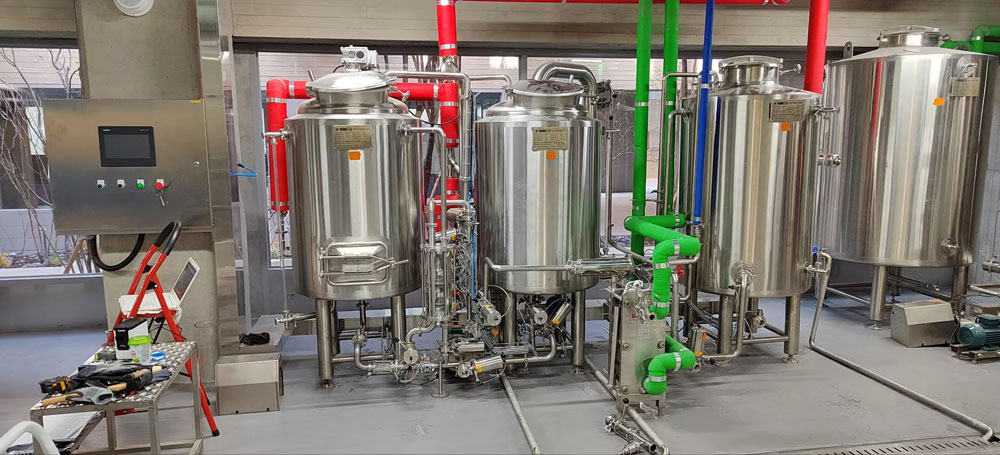
Custom brewing solutions focus on the synchronization of the mash tun, kettle, and cellar control units to act as a unified industrial circuit. Using a bespoke craft beer equipment package ensures that every pump, valve, and sensor is calibrated to the specific flow rates and batch volumes of the facility. This precision removes the guesswork of piece-meal systems where mismatched pipe diameters often cause cavitation, leading to shear stress on yeast and unwanted oxidation.
A 2024 analysis of 120 regional breweries found that plants with custom-integrated piping manifolds reduced their batch-to-batch flavor drift by 40% compared to those using standard flexible hosing. Precise fluid dynamics ensure that the wort moves through the heat exchanger at a constant velocity, which stabilizes the cold-break process and prevents haze inconsistencies in the final product.
The integration of automated temperature controls represents the significant leap in achieving product stability by removing manual monitoring errors. Custom systems utilize proportional-integral-derivative (PID) controllers that adjust steam flow to jackets in real-time, preventing the overshoot of mash temperatures. Keeping the saccharification rest within a 0.5°C window ensures that the fermentability of the wort and the final dryness of the beer remains identical every time a recipe is loaded.
| Variable | Standard Equipment | Custom Integrated System | Impact on Consistency |
| Temp. Tolerance | ±1.5°C to 2.0°C | ±0.2°C to 0.5°C | Precise enzyme conversion |
| Wort Clarity | Visual check only | Inline Turbidity Meters | Uniform protein removal |
| Oxygen Pickup | 50 - 100 ppb | < 20 ppb | Enhanced shelf stability |
| Flow Control | Manual Valves | Automated VFDs | Consistent hop utilization |
Inline monitoring tools within custom hardware allow for the immediate detection of deviations before a batch is impacted beyond repair. Sensors for turbidity, pH, and conductivity provide a data-dense view of the brewing process that manual sampling cannot match during active shifts. In a 2025 brewery survey, operators using inline pH monitoring reported a 15% reduction in total brew time due to faster, more accurate adjustments during the sparging process.
Custom milling ensures precision-set rollers create a uniform grain crush, which stabilizes the lautering speed and prevents stuck mashes that alter the intended mineral balance. Hydraulically controlled rakes maintain a consistent grain bed porosity, ensuring the extract yield does not fluctuate batch-to-batch, while custom-calculated vessel diameters ensure that trub is collected in a tight cone, preventing solid carryover into the fermenter.
The geometry of the vessels directly impacts the chemical reactions occurring during the boil and whirlpool stages by controlling surface area exposure. Custom kettles are designed with a specific height-to-diameter ratio to optimize the rolling boil and ensure the evaporation of dimethyl sulfide (DMS) at a constant rate. Inconsistent DMS removal is a primary cause of off-flavors, a defect detected in 18% of samples from non-customized startups in a 2023 quality audit.
Maintaining a constant evaporation rate of 8-10% per hour through custom steam venting ensures that the hop oils are isomerized uniformly, keeping the IBU levels perfectly aligned with the recipe targets.
Cellar management is the final stage where custom equipment protects the integrity of the product from environmental fluctuations. Custom-jacketed unitanks allow for individual cooling zones, ensuring that the thermal gradient within a 60-bbl tank remains uniform from the top to the cone. This prevents spots where yeast might produce excess esters or higher alcohols, which can deviate from the brand's intended flavor profile by over 25% in poorly insulated tanks.
Zoned cooling allow for cooling only the liquid volume present, preventing icing of the tank walls during partial fills. Custom-set Pressure Relief Valves (PRVs) ensure that natural carbonation levels stay within 0.05 volumes of CO2, while built-in spray balls are mapped to the tank's internal surface area, ensuring 100% microbial removal and preventing cross-batch contamination.
The effect of these technical advantages is a faster return on investment through the elimination of batches that do not meet specification. Data from European craft producers suggests that moving to a custom-automated platform reduces the re-brew rate from 5% to less than 0.5% annually. For a mid-sized facility, this reliability saves thousands of gallons of water and significant energy, allowing the business to focus on market expansion rather than quality troubleshooting.
Custom hardware turns the art of brewing into a repeatable industrial science by standardizing the physical environment. When the equipment handles the mechanical variables of pressure, temperature, and flow, the brewer is free to innovate while knowing the base product will meet consumer expectations. In a market where 82% of craft drinkers cite consistency as a top factor for brand loyalty, the investment in custom infrastructure becomes the primary driver for growth.