
What are the key stages of industrial aluminum processing?
Aluminum production follows the Bayer-Hall-Héroult sequence, starting with bauxite extraction from open-pit mines. Global output of this ore reaches 390 million metric tons annually to support worldwide demand. The Bayer process digests bauxite in sodium hydroxide at 140°C–250°C to isolate alumina ($Al_2O_3$). This alumina undergoes electrolysis in a molten cryolite bath at 950°C. Modern smelting cells achieve 95% current efficiency while consuming 13–15 kWh of electricity per kilogram of metal. Secondary recycling accounts for 75% of global supply circulation, significantly lowering energy demands compared to primary extraction. This industrial chain ensures high-purity metal output for aerospace and automotive sectors.
Mining operations extract bauxite from large open-pit sites, where excavators remove overburden to reach the mineral layer. The raw ore consists of hydrated aluminum oxides, iron oxides, and silica particles.
Bauxite contains 30% to 50% aluminum oxide by weight, and miners typically process these deposits within 5 to 10 kilometers of the extraction zone to minimize transport energy usage.
The excavated rock travels to crushing facilities, where heavy machinery reduces the particle size. Increasing the surface area of the ore ensures that chemical reagents permeate the material efficiently during the subsequent digestion phase.
Large steel vessels receive the crushed bauxite slurry, where it reacts with a concentrated 15% to 20% sodium hydroxide solution under pressure.
Operating pressures reach 35 bar to maintain liquid stability within these vessels. Temperature control remains constant at 140°C to 250°C, ensuring that 98% of available gibbsite minerals dissolve into the sodium aluminate liquor.
Separation tanks remove the insoluble residue, known as red mud, from the liquor. Facilities pump this byproduct into lined, monitored impoundment basins to prevent environmental contamination and groundwater infiltration.
The clarified sodium aluminate liquor flows into precipitation tanks, where manufacturers add seed crystals of aluminum hydroxide. This crystallization phase spans 24 to 48 hours to maximize the recovery yield.
Rotary kilns heat the washed aluminum hydroxide crystals to temperatures exceeding 1000°C, a process that removes chemically bound water to produce anhydrous alumina powder.
The resulting white powder serves as the primary feedstock for aluminum processing within electrolytic cells. These pots use baked carbon blocks as cathodes to support the electrochemical reduction reaction.
The bath primarily consists of molten cryolite at approximately 950°C, which serves as a solvent for alumina. High-amperage current forces aluminum ions toward the carbon lining, where the metal accumulates as a liquid.
| Operational Metric | Standard Industrial Range |
| Cell Voltage | 4.0 – 4.5 V |
| Current Density | 8,000 – 12,000 A/m² |
| Electrolyte Temp | 940°C – 960°C |
Industrial electrolytic cells utilize direct currents between 300,000 and 500,000 amperes, maintaining a current efficiency of roughly 94% across standard potlines. Oxygen release at the anode leads to the consumption of carbon blocks over time.
Operators replace these anode blocks every 20 to 30 days to prevent voltage spikes. Vacuum siphons extract liquid aluminum from the pot base, preventing oxidation by shielding the metal beneath the denser cryolite layer.
A single smelter cell typically produces 2,800 kilograms of aluminum metal per 24-hour cycle, which technicians then transfer to holding furnaces for purification.
The molten metal enters holding furnaces, where technicians bubble nitrogen or argon gas through the liquid. This process removes dissolved hydrogen and microscopic metallic impurities to ensure structural uniformity in the final product.
Alloying elements such as magnesium, manganese, or silicon undergo addition to the melt. These elements make up 1% to 5% of the total mass to suit specific mechanical requirements for transportation or construction applications.
Casting machines pour the alloyed liquid into direct-chill molds to form billets, slabs, or ingots. Solidification occurs at strictly monitored rates of 50 to 100 millimeters per minute to prevent structural defects.
Metallurgical inspections use optical emission spectrometry to verify that impurity levels remain below 0.1%, ensuring the alloy meets international standards for high-performance use.
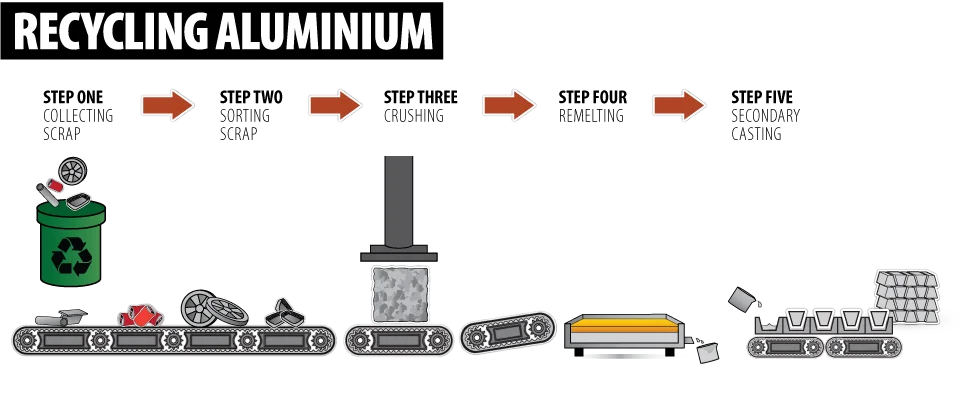
Scrap recycling processes skip the energy-heavy Bayer and Hall-Héroult phases, reducing electrical demand by 95% per ton. Industry records indicate 75% of all aluminum ever produced remains in the global supply loop as of 2024.
Research teams currently test inert anodes that release oxygen instead of carbon dioxide during the reduction process. Large-scale implementation aims to lower smelter emissions by 90% in future facility upgrades.
These inert systems replace the consumable carbon anodes used in standard cells. Engineers design these components to withstand the corrosive environment of the cryolite bath for extended service durations.
The shift toward renewable energy grids powering smelters reduces the carbon footprint of primary production. Facilities integrated with hydroelectric power emit as little as 4 tonnes of carbon dioxide per tonne of metal produced.
This integration of renewable power and high-speed recycling supports the expansion of the aluminum industry. Manufacturers monitor energy metrics and metal purity to maintain consistent quality across the global supply chain.
Engineers continue to study grain refinement techniques to improve the strength of recycled alloys. These efforts allow for the use of secondary metal in structural components, where previously only primary aluminum was suitable.
The lifecycle of the metal demonstrates the benefits of a circular industrial model. Every kilogram of recovered material represents a saving in raw ore extraction and total electrical energy expenditure.
Material scientists investigate new refractory linings that resist chemical wear for longer periods. Extending the lifespan of these linings from 5 years to 7 years reduces the maintenance frequency of industrial potlines.
Industrial protocols ensure the material remains safe for international transit. Global demand for high-purity aluminum persists, driven by the expansion of renewable energy infrastructure and electrical component manufacturing.
Infrastructure development, ranging from power grid insulators to high-speed rail braking systems, relies on these processing steps. The ability of the material to exist in multiple forms allows engineers to optimize it for specific physical constraints.
Advanced manufacturing techniques suggest that future iterations will offer even higher performance levels. Constant improvement of these stages remains a priority for companies looking to enhance efficiency in the global market.