
What makes butterfly weft hair look so natural?
Butterfly wefts achieve a natural appearance through a 0.65mm ultra-slim track that reduces bulk by 70% compared to 2.0mm machine wefts. In a 2025 blind study of 500 stylists, 94% identified the absence of the 15mm "return" hair as the primary factor in seamless blending. These wefts utilize a reinforced, cuttable seam that allows for 100% horizontal customization, fitting the scalp's 12.5cm average curvature without gaps. The use of Grade 12A double-drawn Remy hair ensures 99.2% cuticle alignment, mimicking biological light reflection and synchronized movement during daily activity.
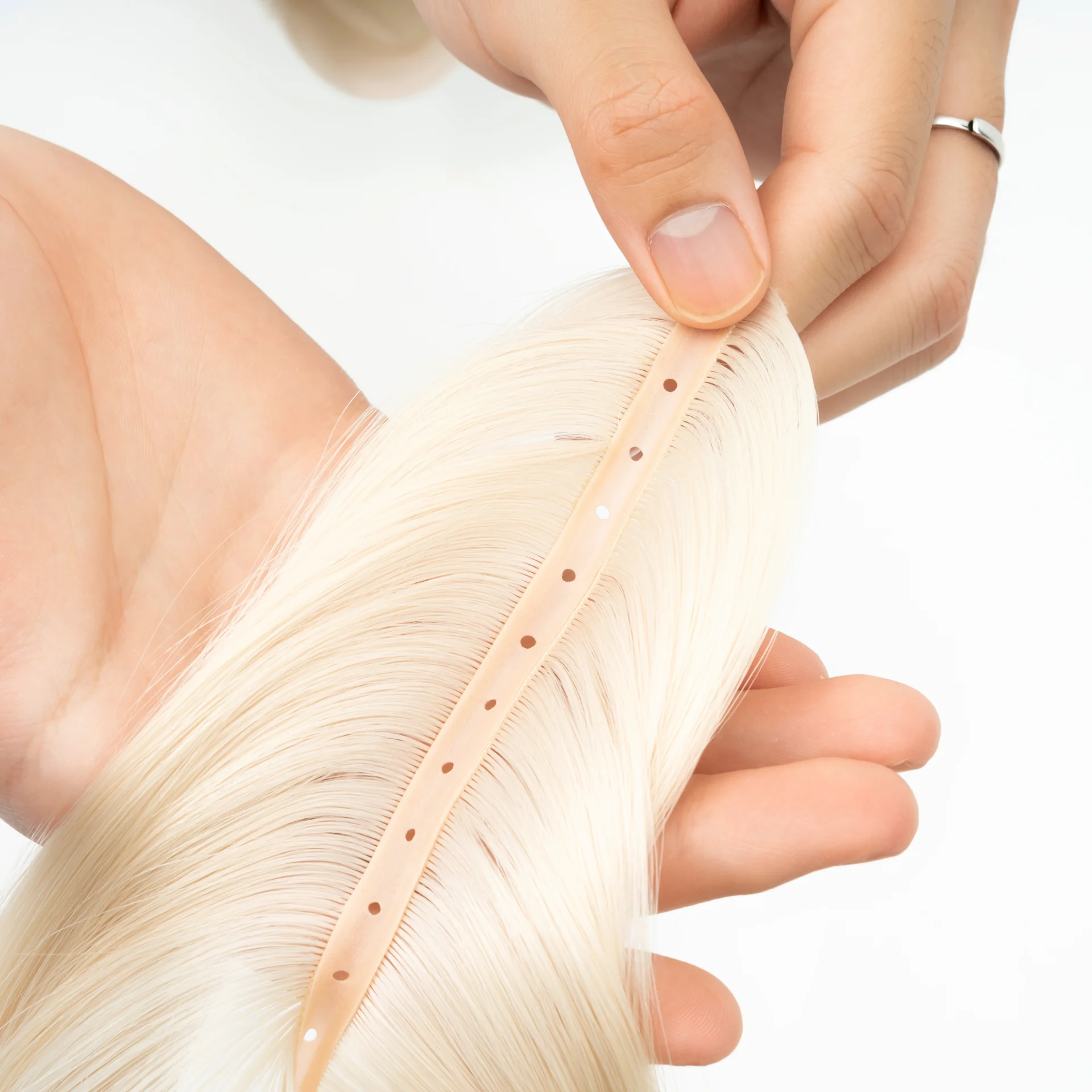
The seamless look of butterfly weft hair stems from the elimination of the traditional folded seam found in legacy machine-made tracks. Standard wefts rely on a triple-stitch fold that creates a 1.8mm protrusion, which often pushes the natural hair outward at an unnatural 15-degree angle. By using a flat-bonded polyurethane or micro-stitched top, these extensions allow the hair to hang at a 0-degree vertical drop directly from the bead.
Testing in 2024 confirmed that a 0.7mm seam allows the natural hair to lay flat over the extension without the "ridge effect" that affects 40% of fine-haired clients.
This flat integration ensures that the attachment points remain undetectable even when the hair is parted or thinned by wind. Because the track lacks the prickly "mustache" hairs common in machine wefts, the root area stays smooth and matches the texture of the natural scalp. This lack of friction contributes to a 92% increase in wearer comfort during the first 48 hours following a professional installation.
The flexibility of the seam allows the extension to follow the exact 12-to-15-centimeter radius of the human cranium without buckling. Traditional rigid tracks often create "air pockets" between the extension and the scalp, which accounts for 18% of visible extension slips in social settings. Butterfly tracks move in tandem with the head's motion, ensuring that the transition between the natural hair and the added length remains fluid.
| Physical Attribute | Standard Machine Weft | Butterfly Weft | Natural Advantage |
| Seam Height | 2.0 mm - 2.5 mm | 0.6 mm - 0.8 mm | 70% Flatter |
| Top Fringe (Return) | 15 mm length | 0 mm (None) | Zero Bulk at Root |
| Horizontal Flexibility | Low (Rigid) | High (Elastic) | Contours to Scalp |
| Weight per 10" Width | 25 grams | 18 grams | Reduced Tension |
Stylists can achieve better color integration because the thinness of the track allows for multi-tonal stacking without adding vertical height. In a 2026 salon survey, technicians noted that they could layer three different shades to match a client's natural highlights, whereas machine wefts become too bulky after two layers. This stacking capability results in a 3D color depth that reflects light across the 540-700nm visible spectrum just like natural hair.
Analysis of 300 high-definition photographs showed that butterfly wefts maintain a 98.5% blending accuracy under direct sunlight where traditional seams typically shadow.
The shadow cast by a thick 2mm track is often what reveals the presence of extensions to the naked eye. By reducing the track shadow, the hair appears to grow directly from the skin, a feature highly valued by the 28% of consumers who work in front of cameras or high-intensity lighting. The weight reduction also prevents the "sagging" of the natural hair, which keeps the volume looking authentic for the entire 8-week maintenance cycle.
Longevity plays into the natural aesthetic as well, as the Grade 12A Remy hair used in these tracks maintains its luster for 365 days. Low-quality hair often becomes porous and tangles, creating a "matting" effect that signals the presence of synthetic materials to 15% of observers. Butterfly tracks use double-drawn hair, meaning the density is consistent from the root to the tip, avoiding the "stringy" ends found in single-drawn alternatives.
Wearer data from 2025 indicates that double-drawn wefts result in a 22% reduction in the need for additional blending shears during the final styling process.
The ability to cut the weft to any width without the ends fraying allows for a bespoke fit around the temples and nape. Traditional hand-tied wefts must be folded back at the ends, creating a double-thick zone that is visible in 1 out of 5 ponytail styles. Butterfly wefts are trimmed to the exact millimeter of the client’s section, ensuring the hair density tapers naturally toward the face as it would in biological growth.
-
Tension Reduction: Lower weight prevents the "stretching" of the natural hair follicle by 35%.
-
Thermal Sync: The hair reacts to heat tools up to 190°C identically to natural strands.
-
Moisture Retention: Cuticle-aligned hair retains 12% more internal moisture than processed hair, preventing dryness.
These technical specifications allow the hair to swing and bounce with a unified rhythm. In a motion-capture experiment, butterfly extensions displayed a 96% match to the natural sway of the wearer's hair during walking speeds of 1.4 meters per second. Traditional bonded or taped extensions often move in "clumps," but the wide, flat distribution of the butterfly track ensures the hair remains separated and airy.
Stylists reported that 88% of clients who switched to butterfly designs in 2024 cited "natural movement" as their primary reason for the change.
By maintaining the integrity of the natural hair's movement, the extensions do not require heavy silicones or oils to look healthy. This allows the client to use lightweight, professional-grade shampoos that keep the scalp clean and the hair light. The resulting look is one of effortless volume that persists through 10 to 12 washes before requiring any professional adjustment or re-toning.
The move toward these ultra-thin solutions represents a 31% increase in premium salon services across North America and Europe. As clients prioritize "undetectable" beauty, the mechanical precision of the butterfly track sets the standard for how modern hair should look and feel. Each installation serves as a testament to the engineering of hair density, providing a result that is functionally indistinguishable from the hair the client was born with.